Capitol Update - February 26, 2026
UEN Legislative Update
February 26, 2026
(Download this week's printable UEN Legislative Written Report)
This UEN Weekly Report from the 2026 Legislative Session includes:
- Deal is Done: School Funding signed by the Governor
- Property Tax Discussions start in the Senate: Governor’s Bill
- House and Senate Floor Action
- Other Funnel Survivors
- Advocacy Actions for the Week
- Advocacy Resources
Deal is Done: School Funding Signed by the Governor
SF 2201 was amended by the House to a proposal agreed upon by the Governor and Senate and House Republicans. The Senate approved the agreement 28 to 20, with Republican Sens. McClintock, Taylor and Westrich joining Democrats in voting no. The House approved the deal 58 to 35, with Republican Reps. Cisneros, Ingels, and Lohse joining Democrats in voting no. The bill, signed by Governor Reynolds, includes the following:
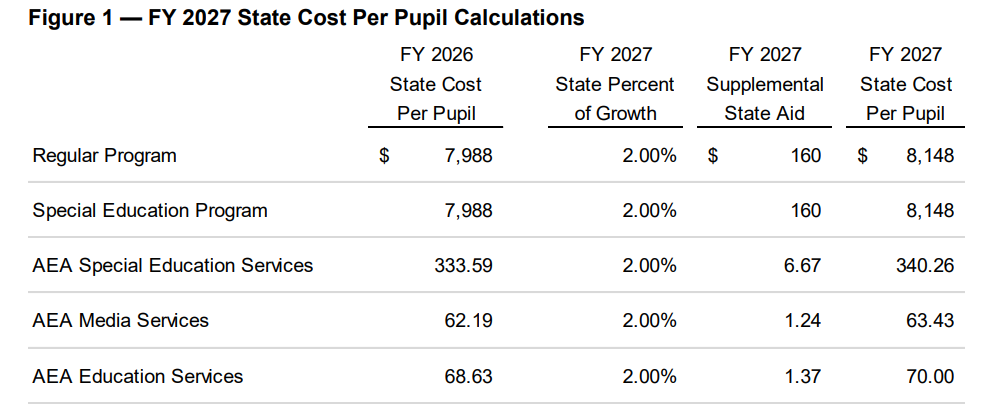
- Increases the state cost per pupil to 2.0% for both regular program and categorical funding.
- Continues the Property Tax Relief Payment (PTRP) for years beginning on and after July 1, 2026, which freezes the property tax portion of the additional levy’s contribution to the state cost per pupil at $153 per student. The State Aid payment will cover what would otherwise have been an increase to property taxpayers for the 2.00% per pupil increase.
- Requires the Department of Management to add a district’s budget adjustment (budget guarantee) to the combined district cost and prohibits the budget guarantee amount from being funded with property taxes. The 2.00% increase places 199 school districts on the budget guarantee, costing the State an estimated $42.2 million.
- Includes provisions contingent on an appropriation for education support personnel salary supplement for the year beginning July 1, 2026. Requires school districts to report education support personnel information to the DE as required and specifies that a school district’s funding supplement shall be its budget enrollment proportional share of $7 million. Defines “education support personnel” as regular and part-time employees of a school district who are not salaried.
- States that Iowa Code 257.8 (30-day deadline to enact school funding) does not apply to this bill.
- Limits transportation equity payments to no more than $1 million per district (effective July 1, 2026). This provision negatively impacts Waterloo and Council Bluffs. The funds these districts would have received to bring their transportation expenses down to the state average will instead be apportioned to other districts with above-average transportation expenditures, estimated at $2.6 million (based on FY 2025 reimbursements).
- Requires DE to complete certified enrollment no later than 30 days after the October count date. Requires a second enrollment count, done on Jan. 15 and certified to DE by Jan. 30. Requires DE to get the January certified count to DOM in 21 days. Requires DE to notify a school district of discrepancies or disputes concerning their enrollment submitted by the district, and specifies that the district has 5 business days to respond. If the district does not respond timely, the DE may certify their enrollment with DE’s corrections. The bill allows a school district to use an audit adjustment for one fiscal year, rather than the current practice. This new adjusted enrollment methodology will apply to school budget years beginning in FY 2028.
- Defines basic enrollment for the budget as the average of the two enrollment counts and enacts this process for school budget years beginning on or after July 1, 2027.
- Requires state aid payments be made quarterly, beginning July 15 of the fiscal year (current law requires monthly payments beginning in September). Also makes transportation equity payments, property tax replacement payments, deductions from state foundation aid for students placed in facilities, deductions from state foundation aid for PK FTEs at the DE.
- Requires DOM to consider the relative budget of the state, cash position of the state resources, and the timing of enactment of legislation affecting school district budgets.
- Requires, beginning July 1, 2027 and in subsequent fiscal years, DOM to deduct media and educational services per pupil amounts from public school districts and pay quarterly to the AEA for the purposes of providing services to students enrolled in nonpublic schools within the boundaries of the AEA.
See the ISFIS New Authority Report for the impact on your district of the 2% increase. The tool also shows the impact on categorical funds, and media and education services.
In consideration of many other bills coming out of both House and Senate Appropriations Committees this funnel week with unfunded mandates and school choice expansions, the $1 million limit on transportation equity for districts, a per pupil increase below the inflation rate, only $7 million for support staff salaries, and the mandate for a second enrollment count which will take administrative resources to accomplish, UEN registered opposed to the 2% deal.
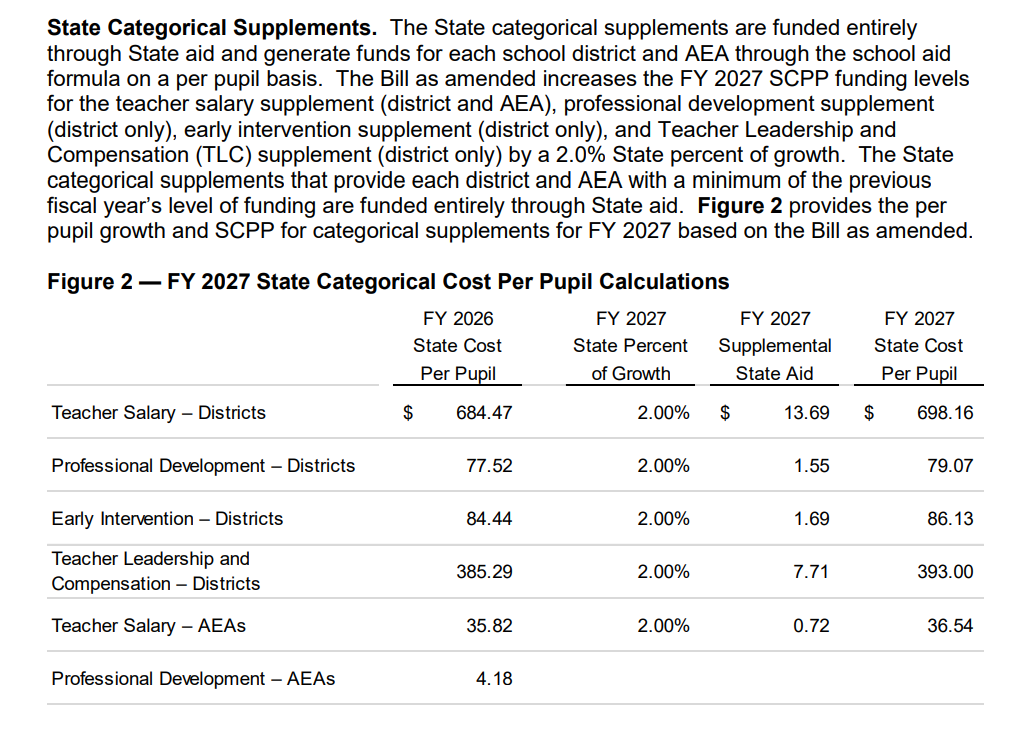
The following charts from the Fiscal Note provide additional details on the impact of the 2% increase per pupil:
Property Tax Replacement Payment (PTRP).
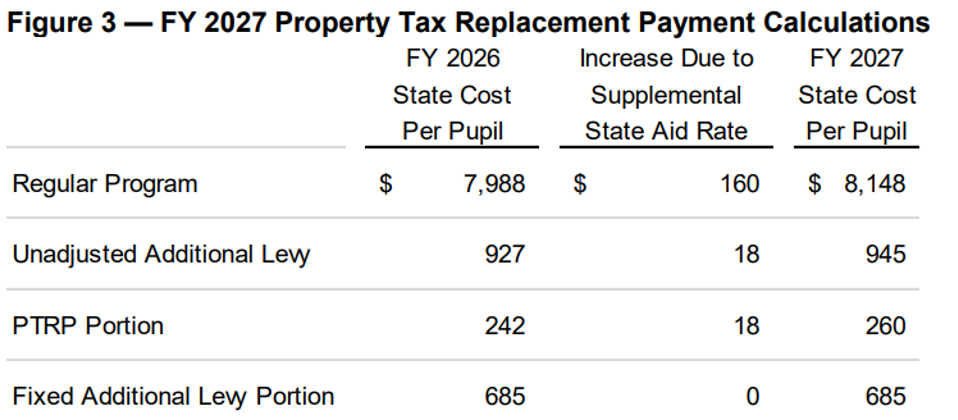
2013 Iowa Acts, chapter 121 (Education Reform Act), created the PTRP provision to replace local property taxes collected by school districts with State aid. The PTRP provision froze the additional levy portion of the SCPP at $750. Based on the State percent of growth enacted during the intervening fiscal years, the PTRP provision created $15 per pupil in property tax relief in FY 2014, which grew to $175 per pupil in FY 2023. The continual growth in PTRP is because the per pupil property tax relief of previous fiscal years is required to be carried forward into future fiscal years. The bill as amended would freeze the additional levy portion of the SCPP at $685 for FY 2027. The per pupil property tax relief amount will be based on the state’s percent of growth enacted for FY 2027. Figure 3 provides details regarding the SCPP funding levels as provided by a 2.0% growth rate for FY 2027 in the bill as amended.
Property Tax Subcommittee in the Senate: Governor’s Bill
The Subcommittee members assigned to SSB 3034 Property Tax Reform/Relief by the Governor met this week to hear input from stakeholders. Sens. Dawson, Bisignano, Schultz, Gruenhagen and Winckler are assigned to the Subcommittee. UEN provided the following comments to the Subcommittee:
UEN is registered undecided on the bill. Schools are primarily budget-limited, so the State has the opportunity to use the school funding decision, like the one you all just sent to the Governor, to deliver tax relief. SF 2201 included $42 million in budget guarantee property tax relief for districts with declining enrollment, relief for growing districts with the second enrollment count (off-sets what would otherwise be on-time funding spending authority in the next year), and for all district, helping with the cash flow challenges by paying state aid quarterly at the beginning of the school year, potentially decreasing demand for cash reserve property taxes.
Schools have concerns about Div. IV which impacts SAVE (State penny for school infrastructure, also known as the Secure an Advanced Vision of Education, or SAVE Fund). The bill accelerates the diversion of SAVE to pay for property tax relief, up to 30% by July 1, 2029. Currently, when sales taxes grow more than 2%, additional funds are carved out of SAVE for property tax relief. The original estimate when the state penny was enacted anticipated hitting the 30% benchmark by 2049. Since SAVE growth is currently limited, it has not kept up with construction costs, which is why so many districts had voters approve bond issues last November. These bond issues are a canary in the coal mine, indicating that reducing SAVE will impact school districts turning to additional bond referenda to fund school projects.
Additionally, school districts are leveraged against SAVE revenue:
- Over 170 school districts have bonded against the sales tax (which was authorized by voter approval of their district revenue purpose statements.) The finance experts at Piper Sandler have analyzed district obligations against SAVE and show many districts at risk of defaulting on those bond payments with this acceleration of SAVE diversion for property tax relief. Districts of all kinds, rural, urban and suburban, would be without the revenue stream to make their bond payments that have obligated SAVE revenue for years forward.
- There is no hold harmless provision in the bill, and if there was, it would create serious equity issues for the districts that are not bonded, as the remaining pool of sales tax to be distributed would be significantly reduced. If there was a backstop, that property taxes via a debt levy would cover any unfunded obligation, that would help, but seems inconsistent with the intent of the bill to provide property tax relief.
- UEN urges the Senate to remove Division IV from the bill.
The Senate has also scheduled a subcommittee to consider SSB 3001, the Senate Republican property tax relief/reform proposal. This bill is very similar to last year’s property tax relief proposal, with significant impacts on valuation (eliminating rollbacks while expanding credits and exemptions), property tax rates (lowers voted levies to 70% of prior rates, both maximums and levies currently imposed, reduces the uniform levy and sets 100% foundation level, with the state picking up significant responsibility of school funding, and limits management fund levy authority based on carry-forward balances). Sens. Dawson, Bisignano, Driscoll, Schultz and Winckler are assigned. UEN is opposed to this bill.
See the ISFIS Side-by-Side Comparison of the three Property Tax Proposals for your reference in reaching out to legislators this coming week. As the Session is now past the first funnel deadline and getting closer to adjournment, expect work on Ways and Means and Appropriations bills to begin in earnest.
Bills to the Governor
SF 2201 SSA School Funding: Raises the state cost per pupil for regular program cost and categoricals by 2%. Increases transportation equity funding and caps the amount at $1 million for a district. In addition to the Oct. 1 enrollment count date, adds a Jan. 15 enrollment count and bases the upcoming fiscal year budget on the average of the two. Pays state foundation aid to school districts quarterly, beginning in July of the fiscal year. Funds para-educator/support personnel at $7 million. Continues to the PTRP beginning July 1, 2026 and in future years (whereby the state pays for what would otherwise be property tax contribution to the district cost per pupil). Requires the state to pay for the budget guarantee, which would otherwise be property taxes. The House passed the bill as amended 58-35. The Senate concurred and passed the bill as amended 27-20; it now goes to the Governor. UEN is opposed.
Floor Action This Week
Bills surviving the first funnel must be approved in their chamber of origin, sent across the rotunda to the other chamber, and be approved by a committee in that chamber to survive the next funnel deadline, which is March 20th.
House Action
HF 2294 Open Meetings/Public Records Complaints: Increases the timeline for filing complaints with the Iowa Public Information Board regarding. Iowa Code Chapters 21 or 22 from 60 to 90 days. The House passed the bill 89-0; it now goes to the Senate. UEN is undecided.
HF 2330 Public Records Requests: Establishes procedures for responding to public records requests. Requires the lawful custodian of public records to: 1) Promptly acknowledge the request and provide contact information for the lawful custodian or designee, 2) provide an approximate date for completion and estimate of reasonable expenses. Also requires the custodian to notify the requester of expected delays in the production of the record. Defines “promptly” to mean using reasonable, good faith efforts to respond, taking circumstances at the time the request was received into account. House approved the bill 89 to 0 it now goes to the Senate. UEN is undecided.
HF 2490 Public Meeting Notice Requirements: Requires giving notice to news media who have requested notice for public meetings, and for posting notices about open meetings in a conspicuous place and on a government website. Requires amended agendas to be marked as amended. The House passed the bill 88-1; it now goes to the Senate. UEN is undecided.
HF 2493 PK Eligibility: expands eligibility and funding for the statewide voluntary preschool program, instead of just four-year-olds, for “young children” defined as four-year-olds and five-year-olds with birthdays before March 1. Applies beginning with the 2027-28 school year. The House passed the bill 88 to 8; it now goes to the Senate. UEN is undecided.
HF 2501 Election Changes: Defines election day to mean any day voting takes place, including voting at satellite stations. Misconduct: Requires the Governor to be notified if the SOS is under investigation for election misconduct. Registration: Cancels a voter registration that is incomplete after 90 days. Recounts: Requires that 1% or 50 voters, whichever is less, for a recount of a 60% bond issue. Changes the makeup of recount boards. Filings: Requires school filings to be with the county auditor (commissioner of elections) rather than the school board secretary. Other: Updates election security provisions. Sets the time for special precinct election boards. Allows voters to receive text updates for absentee ballots. Strikes outdated county auditor requirements, bar code requirements on absentee ballots and on attesting a ballot at the poll. Changes Broadlawns voting provisions. The House passed the bill as amended 67-22; it now goes to the Senate. UEN is undecided.
HF 2547 Concurrent Enrollment Program & Community College Summer Program Funding: Modifies provisions related to career academies, the collective statewide articulation agreement between community colleges and the state board of regents, the district-to-community college sharing or concurrent enrollment program, qualifies summer community college course work as eligible for supplementary weighting, specifies that a community college course that earns college credit satisfies the time requirement for high school credits, and requires a conversation with students for individual career and academic planning. The bill was amended to require the state Board of Regents to submit a report to the General Assembly and the Governor describing the process for establishing a performance-based funding model for higher education institutions. The fiscal note explains the potential impact to the State of including summer school concurrent enrollment in supplementary weighting. “House File 2547 is estimated to increase supplementary weighting paid through the supplementary school aid formula by $962,000 in FY 2027 and by $1.1 million in FY 2028 if 100.0% of students are enrolled in CTE courses. However, if 75.0% of students enroll in CTE courses and 25.0% of students enroll in college-level liberal arts and sciences courses, the bill is estimated to increase supplementary weighting by $893,000 in FY 2027 and $1.0 million in FY 2028.” This bill was submitted by the DE. The House passed the bill, 90-0; it now goes to the Senate. UEN supports.
Senate Action
SF 274 School Sport Entry Fees: Requires public schools and registered athletic organizations to accept cash at the gate. The Committee members amended the bill to exempt private facilities that operate only on an electronic basis. The Senate passed the bill 44-0; it now goes to the House. UEN is undecided.
SF 2086 Junior Firefighter Program: allows schools to create a junior firefighter program for juniors and seniors. Requires the school to coordinate with the fire training bureau and the local fire department. Requires the school to have an agreement in place with a fire department prior to starting the program. Includes requirements for the program. The Senate passed the bill as amended 47-0; it now goes to the House. UEN supports.
SF 2218 Legal Authorization to Work for Licensure: Requires the BOEE to require applicants for licensing or license renewal show proof of legal authorization to work in the United States. Requires practitioners not subject to licensing to show proof of legal residence every five years. Requires school boards, and directors of private schools and charter schools to verify legal authorization to work in the U.S. for newly hired employees. The Senate passed the bill as amended 47-0; it now goes to the House. UEN is undecided.
SF 2219 FFA/4-H Absences: Requires the school board (public, private and charter) to adopt policies excusing school absences for 4-H/FFA activities. Requires the student be allowed to make up missed work. During the Senate debate, an amendment changed the absences from excused to exempt. The Senate passed the bill as amended 46-0; it now goes to the House. UEN is undecided.
SF 2224 Computer Science Course Flexibility: Specifies that CTE courses related to technology, engineering or manufacturing may count towards offer and teach computer science requirements. Allows computer science instruction to be delivered through dedicated coursework or through other coursework that meets the requirements. Requires the State BOE to adopt rules. Requires the State BOE to include content in computer science standards regarding artificial intelligence. Also requires teacher preparation institutions to include content on artificial intelligence, first required for students entering teacher preparation programs July 1, 2028. The Senate passed the bill as amended 47-0; it now goes to the House. UEN supports.
SF 2263 Transporting Weapons: Allows a person to have a dangerous weapon in a parking lot for a state or local government, or Regent school or community college, or school, if the weapon is out of sight and in a locked car. Prohibits HHS from adopting rules that bar a person transporting foster children from having a weapon in the vehicle. Although the bill originally allowed carrying concealed weapons in cars on school grounds (and in parks), those provisions were amended out of the bill. Current law requiring double the fines or sentences for having a gun within 1,000 feet of a school remains. The Senate passed the bill as amended 35-12; it now goes to the House. With the amendment excluding schools, UEN has changed registration to undecided.
SF 2299 Concurrent Enrollment/Community College Courses: Allows a school superintendent or their designee to require a high school student who takes a community college class through the school and fails the class to pay for the school for the cost of the course. The Senate passed the bill 32-16; it now goes to the House. UEN supports.
SF 2351 Open Enrolled Truants: requires students identified for chronic absenteeism interventions, including participation in a school engagement meeting, is not allowed to open enroll out of the district until the attendance and truancy concerns are corrected. Notwithstands that provision, if the receiving district approves the open enrollment. Removes the exemption from the March 1 open enrollment application deadline applying to online academies (this provision was amended out of the bill). The Senate passed the bill as amended 44-0; it now goes to the House. UEN supports.
SF 2412 E-Verify System Checks: Requires state agencies, local governments, schools, the Regents and the Legislature to use the E-Verify system to verify the citizenship and status of any newly-hired employee. Requires DIAL to set up a clearinghouse for SAVE requests for professional licensing boards to use the SAVE system. Includes an appeal process and reporting requirements for the Regents, schools and local governments. The Senate passed the bill as amended 47-0; it now goes to the House. UEN is undecided.
SF 2430 Displaying Flags: Requires public buildings to display flags at half-staff when the Governor orders them to be displayed at half-staff. Allows reports of noncompliance to the Attorney General. Gives the Attorney General enforcement powers to initiate a proceeding to enforce compliance, including, but not limited to, seeking injunctive relief. The Senate passed the bill 38-9; it now goes to the House. UEN is undecided.
Other Notable Funnel Survivors
These bills, having cleared a committee in their chamber of origin this week, survived the Feb. 20 funnel deadline as they move to their respective calendars. Study bills approved by a committee in their chamber of origin receive a new bill number after committee approval. Bills authored by individual legislators may retain the same bill number or may be assigned a new bill number if the Committee approves the bill as a Committee bill. New numbers are listed below, if known.
House Education Committee:
HF 460 Play-Based Learning in PK-Kindergarten: UEN supports.
HF 621 Guns on School Grounds: UEN opposes.
HF 2218 Recording Special Education Classes: UEN opposes.
HF 2306 Documentation of Teachers Reading IEPs: UEN is opposed.
HF 2307 Coaching Authorization Light: UEN is undecided.
HF 2393 ESA Categorical Funding Flexibility: UEN supports.
HF 2451 Digital Instruction Limitation K-5: UEN is undecided.
HF 2699 Charter Schools by the Governor: UEN is opposed.
HF 2724 Teaching Endorsements for Math, Science, Fine Arts: UEN supports.
HF 2705 School Flexibility and Deregulation: UEN supports.
HF 2725 DE Reporting and Annual Condition of Education Report: UEN is undecided.
HF 2713 Charter Schools Changes and Other Matters: UEN is opposed to the charter school provisions, primarily funding and PK but supports the Health Related Trainings Task Force.
HF 2670 Education Omnibus (Social Studies, Financial Literacy, Noncompliance): UEN is undecided.
HF 2591 Open Enrolled Sports Waiting Period 140-calendar days: UEN supports.
HF 2610 Career & Technical Education Services by DE: UEN is undecided.
SF 176 Open Enrolled Online Extracurriculars: UEN supports.
Senate Education Committee:
SF 2351 Open Enrolled Truants: UEN supports.
SF 2361 Civics Seal of Excellence: UEN supports.
SJR 2008 DOE/State Power Resolution: UEN is undecided.
SF 2428 School Violence Policies: UEN is undecided.
SF 2390 School AED Grants: UEN is opposed (but reviewing amendment to reassess.)
SF 2413 Government Instruction Grades 7-8: UEN is undecided.
SF 2405 School Materials: UEN is opposed.
SF 2425 Charter School Matters: UEN support the health-related trainings task force but opposes funding and PK provisions.
SF 2404 Special Education Pilot Project: UEN is opposed.
SF 2392 Homeschool Sports Scrimmages: UEN is undecided.
SF 2403 WGS and Reorganization Incentives: UEN is undecided.
SF 2391 Career & Tech Services Updates by DE: UEN is undecided.
SF 2407 Condition of Education Reports: UEN is undecided.
SF 2406 Charter Schools by the Governor: UEN is opposed.
Other Committees:
HF 2528 AI/Cyber Security Education: DE digital educational hub. UEN is undecided.
HF 2029 Schools in State Health Insurance Pool: (still awaiting new bill number) UEN supports.
HF 2623 Local Elections: School board election at a General Election and additional June bond issue date. UEN is opposed to the change in school board elections but supports the additional bonding election opportunities and corrections.
HF 2712 Early Childhood System Changes: referred to Appropriations Committee. UEN is undecided.
HF 2592 and SF 2286 Joint Investment Trust Public Investments: UEN is opposed.
SF 493 Local Government Lobbyists Prohibited: UEN is opposed.
SF 2436 School District TIF Revenue: UEN supports.
Dead Bills:
Bills that do not survive the February 20th deadline remain in the House and Senate Education Committees, are technically dead.. It is important to note that bills that are moving can be amended to include provisions from dead bills. Additionally, ways and means (tax) bills and appropriations (spending) bills are exempt from the funnel deadlines. A list of dead bills from the House and Senate Education Committees follows at the end of this report.
Advocacy Actions This Week
Property Tax Reform: Contact legislators regarding property tax reform. Ask them how the conversation is going. What questions do they have?
The Governor’s version is more modest than the Senate’s, but still accelerates SAVE funds within a very short time frame, negatively impacting resources available for school infrastructure, safety and equipment. This proposal removes an estimated $200 million annually from school infrastructure, technology, safety, equipment, buses and construction in four years. Reach out to the experts at Piper Sandler to discuss the point at which your district may be at risk of defaulting on bonds if SAVE is reduced based on the Governor’s proposal. See Piper Sandler’s SAVE Bond Default Risk Calculator
Talking Points:
- Property Tax Relief or Reform? Encourage legislators to get fiscal estimates before proceeding with big system changes. The impact of multiple changes to all three components of the system is very hard to predict. If reform reduces revenue, it is property tax relief.
- Much of the Governor’s version spares schools. One concern is the acceleration of SAVE funds to property tax relief, negatively impacting resources available for school infrastructure, safety and equipment ($200 million off the table in 4 years). Many districts are bonded against the SAVE, so they may be put into a default situation. A reduction in SAVE would require schools to turn increasingly to bond issues and ask voters to raise PPEL rates. If voters don’t approve, districts will have to reduce SAVE currently used for safety, technology, updated buses and equipment. Noninstructional software and buses are expensive. If they are to be paid from the general fund, schools will have to further reduce staff or delay upgrades.
- Policies do not change in isolation. Low SSA and declining enrollment, with the State taking over budget guarantee, should already lower school property tax burdens for taxpayers.
See the UEN Property Tax Reform 2026 Issue Brief for additional talking points and items to discuss with your legislators. See the ISFIS Property Tax Comparison Side-by-Side, which compares and contrasts the ideas in all three.
SSA and Unfunded Mandates: Now that SSA is done, ask legislators to resist every unfunded mandate that has moved forward through a committee. Unfunded mandates increase the need for administrative time and energy, pulling instructional leaders away from supporting teachers with literacy and math plan implementation and helping with behavior issues. Also, ask them to carefully consider enactment dates of mandates and policies that do move forward, so schools have enough time to await state BOE rules and DE guidance, develop local policies, train staff and align or correct current curriculum, standards and lesson plans.
Thank legislators for the bills moving forward that UEN supports!
Connecting with Legislators: To call and leave a message at the Statehouse during the legislative session, the House switchboard operator number is 515.281.3221 and the Senate switchboard operator number is 515.281.3371. You can ask if they are available or leave a message for them to call you back. You can also ask them for the best way to contact them during the session. They may prefer email, text message, or a phone call, based on their personal preferences.
Find out who your legislators are through the interactive map or address search posted on the Legislative Website here: https://www.legis.iowa.gov/legislators/find
Other UEN Advocacy Resources:
Check out the UEN Website at www.uen-ia.org to find Issue Briefs, these UEN Weekly Update Reports and Videos, UEN Calls to Action when immediate advocacy action is required, testimony presented to the State Board of Education, the DE or any legislative committee or public hearing, and links to fiscal information that may inform your work. The latest legislative actions from the Statehouse will be posted at: www.uen-ia.org/blogs-list. The 2026 UEN Advocacy Handbook will be available and posted soon at www.uen-ia.org/advocacy-handbook.
Contact Us
Margaret Buckton
UEN Executive Director
margaret@iowaschoolfinance.com
515.201.3755 Cell
Thanks to our 2025-26 UEN Corporate Sponsors:
Special thank you to your UEN Corporate Sponsors for their support of UEN programs and services. Find information about how these organizations may help your district on the Corporate Sponsor page of the UEN website at www.uen-ia.org/uen-sponsors.
- 10Fold Architecture + Engineering - www.10foldarchitecture.com
- INVISION Architecture - www.invisionarch.com
- Solution Tree - www.solutiontree.com/st-states/iowa
Bills in the House Education Committee not Surviving the 2/20/2026 Funnel
|
Creates reporting requirements for accredited nonpublic schools and the department of education concerning education savings account funds. |
|
|
Requires boards of directors of school districts, the authorities in charge of accredited nonpublic schools, and the governing boards of charter schools to adopt policies related to excusing the absences of students enrolled in grades six through twelve for civic or political events. |
|
|
Requires DE to develop and administer a pilot program that authorizes school districts and charter schools to offer instruction in logic and critical thinking. |
|
|
Requires the employment of temporary licensed mental health counselors by school districts, accredited nonpublic schools, charter schools, and innovation zone schools. |
|
|
Requires school district general fund flexibility accounts by expanding eligible uses to include costs to expand preschool programs. |
|
|
Establishes a data security program within the DE, and making appropriations. |
|
|
Changes the statewide preschool program by modifying provisions relating to eligibility, funding, and compulsory attendances. |
|
|
Modifies provisions related to when children may enroll in kindergarten; when students enrolled in kindergarten in school districts, charter schools, or innovation zone schools may be promoted to first grade; and the responsibilities of school districts, charter schools, and innovation zone schools related to the discipline of students who cause violent or nonviolent disruptions. |
|
|
Establishes the office of the inspector general for school safety and modifying the duties of school districts, and making appropriations and providing penalties. |
|
|
Changes requirement of health instruction and health education instruction provided to students enrolled in school districts, charter schools, and innovation zone schools in grades one through twelve. |
|
|
Establishes a school resource officer grant program within the DE, and includes appropriations. |
|
|
Requires school districts, accredited nonpublic schools, charter schools, and innovation zone schools to grant coaches leaves of absence to attend professional development activities. |
|
|
Modifies provisions related to private instruction and dual enrollment, and includes effective date. |
|
|
Requires the enactment of supplemental state aid and the suspension and forfeiture of legislative pay. |
|
|
Changes responsibilities of school district teachers and other educational staff related to students who have individualized education programs or plans under section 504 of the federal Rehabilitation Act. |
|
|
Modifies provisions related to the social studies curriculum, core curriculum, graduation requirements, AEAs, and high school GEDs, and including transition provisions and effective date. |
|
|
Allows schools to establish and offer a junior fire fighter program to high school students. |
|
|
Changes requirements regarding the sale of certain specified buildings or structures by school districts. |
|
|
Addresses requirements associated with licenses issued by the BOEE to certain specified practitioners. |
|
|
Modifies provisions related to world language instruction requirements. |
|
|
Requires standards and performance measures for public libraries. |
|
|
Modifies eligibility for payments under the education savings account program, and including effective date provisions. |
|
|
Requires BOEE to establish authorizations for instruction related to fine arts. |
|
|
Requires radon testing in schools, including responsibilities of nonpublic schools, applicability to charter and innovation zone schools, establishing a school testing and mitigation of radon grant program within the DE, making appropriations, and including effective date provisions. |
|
|
Requires the eligibility of students enrolled in nonpublic schools to participate in show choir and marching band provided by public schools, and including effective date provisions. |
|
|
A bill for an act requiring the boards of directors of school districts to allow certain youth-oriented community organizations reasonable access to school property. |
|
|
Changes the application deadline for the education savings account program. |
|
|
Changes testing requirements applicable to pupils who are participating in the education savings account program. |
|
|
Requires minimum roster sizes for interscholastic sports. |
|
|
Requires community colleges, school districts, and institutions under the control of the state board of regents to adopt policies related to the use of artificial intelligence by students and employees. |
|
|
Repeals the school tuition organization tax credit available against the individual and corporate income taxes and including effective date provisions. |
|
|
Appropriates funds to the DE for the therapeutic classroom incentive grant program. |
|
|
Authorizes school districts to use revenues from the district management levy for targeted staff retention incentives and including applicability provisions. |
|
|
Modifies provisions related to prohibited diversity, equity, and inclusion offices and officers and to trainings and curricula regarding specific defined concepts provided by state entities and school districts. |
|
|
Requires trainings and curricula regarding specific defined concepts provided by public institutions of higher education and school districts. |
|
|
Creates an opportunity tax credit available against the individual income tax, for resident dependents not enrolled in a public school or receiving an educational savings account payment. Creates a fund, makes appropriations, and includes effective date and retroactive applicability provisions. |
|
|
A bill for an act authorizing the expenditure of funding from the secure an advanced vision for education fund for certain insurance costs related to school boards authorizing staff to carry guns. |
|
|
Requires community-based providers be independently authorized for participation in the statewide voluntary preschool program for four-year-old children. |
|
|
A bill for an act providing for supplementary weighting for school districts that share school and career specialists. |
|
|
Requires the discipline of students who disrupt the educational process, and including effective date provisions. |
|
|
Mandates education related to the holocaust for students and teachers in school districts. |
|
|
Requires nonpublic school student participation in extracurricular interscholastic activities provided by public schools. |
|
|
Requires DE to develop and administer a pilot program that requires certain specified school districts to establish attendance centers for students requiring special education and students with behavioral issues. |
|
|
Requires the legislative council to enter into an agreement with a qualified person to conduct a review of Iowa’s public education system, and including effective date provisions. |
|
|
A bill for an act establishing the school health-related emergency response plan competitive grant program within the department of education, making appropriations for competitive grants. |
|
|
A bill for an act relating to practitioner preparation programs, including by modifying the preparation required to be included in practitioner preparation programs and the duties of the state board of education and the director of the department of education, and including applicability provisions. |
|
|
A bill for an act relating to education, including by modifying provisions related to the physical education and physical activity requirements applicable to certain specified students and by implementing a graduation requirement related to participation in a co-curricular or extracurricular activity. |
|
|
A bill for an act relating to education funding by authorizing community-based providers to directly participate in the statewide preschool program for four-year-old children, modifying the school tuition organization tax credit program. |
|
|
A bill for an act relating to the inclusion of the internet address for the your life Iowa program or successor program on public school student identification cards and including applicability provisions. |
|
|
A bill for an act relating to education, including by modifying provisions related to the Iowa statewide assessment of student progress and programs for gifted and talented children, and by requiring school districts to develop an advanced mathematics pathway and implement procedures for subject acceleration and whole-grade acceleration. |
|
|
A bill for an act requiring the board of educational examiners to issue certificates when directed by the board of directors of a school district to individuals who have attained a minimum of a baccalaureate degree and who have expertise or significant professional experience in a subject area that allows the individual to provide instruction in that subject area to students enrolled in the school district in grades nine through twelve. |
|
|
A bill for an act relating to cooperation by public and private schools with federal immigration and customs enforcement officers. |
|
|
A bill for an act relating to physical education requirements for students enrolled in grades seven through twelve in school districts, charter schools, and innovation zone schools. |
|
|
A bill for an act modifying provisions related to the minimum amount of instruction provided to students enrolled in school districts, accredited nonpublic schools, charter schools, and innovation zone schools. |
|
|
A bill for an act relating to mathematics instruction, including by requiring school districts, charter schools, and innovation zone schools to develop an advanced mathematics pathway that is designed to enable students to succeed in courses related to algebra in grade eight. |
Bills in the Senate Education Committee not Surviving the 2/20/2026 Funnel
|
Establishes a classroom supply stipend for certain public school teachers, and making appropriations. |
|
|
Modifies provisions related to the duties and powers of AEAs, the DE, and AEA funding, and including effective date. |
|
|
Changes to school lunch programs provided by school districts, charter schools, and innovation zone schools, making appropriations, and including effective date provisions. |
|
|
Requires school boards, the authorities in charge of accredited nonpublic schools, and the governing boards of charter schools to adopt policies related to excusing the absences of students enrolled in grades six through twelve for civic or political events. |
|
|
Repeal of the education savings account program. |
|
|
Mandated education on the holocaust for students and teachers in school districts. |
|
|
Creates a new graduation requirement for instruction related to food nutrition and preparation. |
|
|
Expands the education savings account program to qualified nonpublic schools. |
|
|
Establishes new charter school requirements, including reporting requirements, governance standards, financial accountability, and oversight by the state board of education. |
|
|
Modifies statewide preschool program funding amounts and eligibility for payments under the education savings account program. |
|
|
Reduces the foundation property tax and repeals the education savings account program, and including effective date. |
|
|
Requires school districts, charter schools, and AEAs to implement certain email security standards. |
|
|
Specifies the ability of persons to examine the public records of school districts. |
|
|
Modifies provisions related to the executive officers of the boards of directors of school districts. |
|
|
Allows civil actions against school board members and superintendents for school policies that violate state law. |
|
|
Expands administrator licensure requirements granted by the BOEE including the requirement to maintain a valid teaching license. |
|
|
Allows retired law enforcement members reemployed as school resource officers under the Iowa public employees’ retirement system and the municipal fire and police retirement system. |
|
|
Defines a bona fide retirement and allows subsequent employment as school district support staff or a coach under the Iowa public employees’ retirement system. |
|
|
Prohibits obscenity exemptions for public libraries and educational institutions. |
|
|
Provisions for student participation in non-school-sponsored athletic contests or competitions. |
|
|
Computer science and artificial intelligence education, including high school curricula and graduation requirements, practitioner preparation programs, and college admissions, and including applicability provisions. |
|
|
Modifies provisions related to the executive officers of the boards of directors of school districts and authorizing residents and employees to request audits of school districts. |
|
|
AEA employee access to student records. |
|
|
Requirement for waiver of tuition and mandatory fees at accredited private institutions and regents institutions for students during student teaching experiences in the state. |
|
|
Modifies provisions related to prohibited diversity, equity, and inclusion offices and officers and to trainings and curricula regarding specific defined concepts provided by the State and school districts. |
|
|
A bill for an act relating to human growth and development course enrollment at school districts and prohibiting pupil attendance at educational conferences or seminars in which human growth and development information is provided. |
|
|
Establishes a nonpublic school safety infrastructure grant program and making appropriations. |
|
|
Requires accredited nonpublic schools to provide special education services to students enrolled in the school who require such services and modifies the responsibilities of AEAs, and including effective date provisions. |
|
|
Repeal of the 2 mile limit to transportation to and from school of pupils participating in open enrollment. |
|
|
Requirements related to nonpublic schools that receive tuition payments from parents or guardians whose students are participating in the education savings account program. |
|
|
A bill for an act authorizing the expenditure of funding from the secure an advanced vision for education fund for certain insurance costs related to school board authorization of staff to carry weapons. |
|
|
Prohibits school districts, charter schools, and innovation zone schools from providing any program, curriculum, test, survey, questionnaire, promotion, or instruction relating to gender theory or sexual orientation instruction in grades seven through twelve. |
|
|
A bill for an act relating to statewide voluntary preschool program students whose household income is below a certain amount, minimum hours required to be offered, and funding calculations. |
|
|
A bill for an act requiring school districts, accredited nonpublic schools, charter schools, and innovation zone schools to provide success-sequence education in grades seven through twelve. |